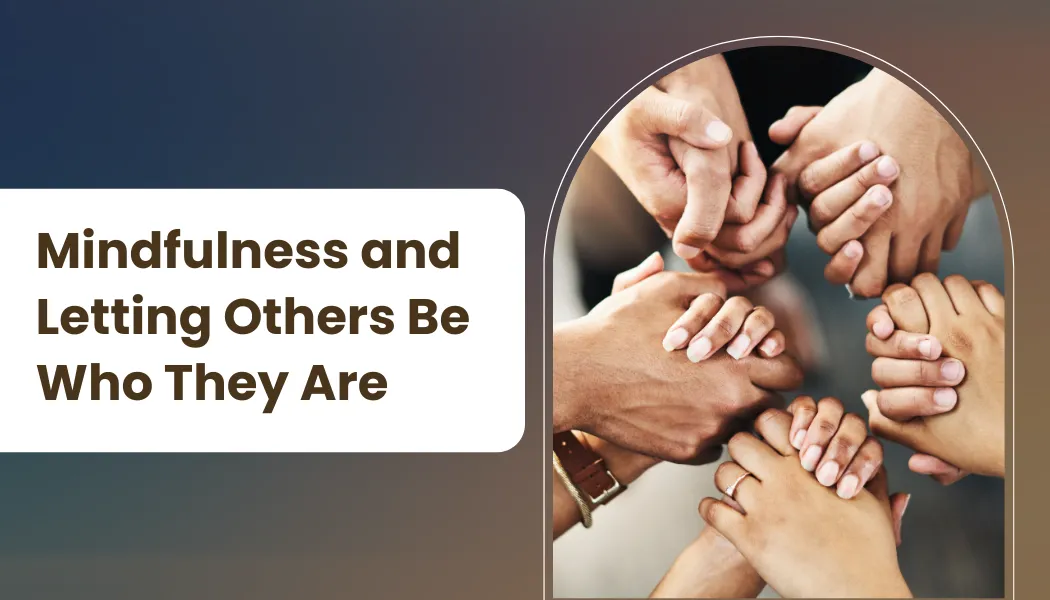
Mindfulness and Letting Others Be Who They Are
One of the quietest sources of stress in our lives isn’t always deadlines or responsibilities.
It’s other people.
It’s wishing they would communicate differently.
Wishing they were more thoughtful.
More motivated.
More emotionally aware.
Less reactive.
Less distant.
More like us.
We rarely admit it out loud, but much of our inner tension comes from wanting others to behave in ways that feel safer, easier, or more comfortable for us.
Mindfulness offers a different path.
Instead of trying to shape people into versions we can better manage, it invites us to see them clearly — and let them be who they are.
This doesn’t mean tolerating harm.
It doesn’t mean abandoning boundaries.
It doesn’t mean silencing your needs.
It means releasing the exhausting habit of mentally redesigning other human beings.
And when you do that, something surprising happens: you feel lighter.
- The Subtle Urge to Control
- Why We Struggle to Let People Be
- The Freedom of Separating “Mine” From “Theirs”
- Mindfulness in Moments of Frustration
- Acceptance Is Not Agreement
- The Exhaustion of Constant Correction
- Allowing Personality Differences
- Letting Go of the Timeline You’ve Created for Them
- The Role of Compassion
- Boundaries Make Letting Go Possible
- Releasing the Fantasy Version of Someone
- When Letting Be Means Letting Go
- The Peace That Comes From Dropping Resistance
- Mindfulness in Real-Time Interaction
- You Cannot Carry Everyone’s Growth
- Living and Letting Live
- The Mirror Effect
- A Gentle Reflection Practice
- Final Reflection: The Gift of Allowing
The Subtle Urge to Control
Control often disguises itself as care.
You might think:
- “I’m just trying to help.”
- “They would be happier if they listened to me.”
- “I know what’s best for them.”
- “If they changed this one thing, everything would be easier.”
Sometimes this impulse is loving. Sometimes it’s protective. Sometimes it comes from anxiety.
But underneath it all is discomfort with uncertainty.
Other people are unpredictable. Their choices affect us. Their moods influence environments. Their actions may trigger old wounds.
Trying to manage them feels like managing risk.
Mindfulness helps us notice this urge — not judge it, just see it.
And seeing it weakens its grip.
Why We Struggle to Let People Be
Letting others be who they are is difficult for several reasons:
1. We Personalize Their Behavior
If someone withdraws, we assume we did something wrong.
If someone criticizes, we question our worth.
If someone is distant, we feel rejected.
2. We Fear Disconnection
We believe that if we don’t intervene, correct, or adjust them, we’ll lose closeness.
3. We Attach Identity to Being Right
Being correct can feel like being safe.
4. We Want Relief
If someone’s behavior causes discomfort, changing them seems easier than changing our response.
Mindfulness doesn’t eliminate these tendencies — it brings awareness to them.
And awareness creates space.
The Freedom of Separating “Mine” From “Theirs”
One of the most powerful mindfulness shifts in relationships is learning to distinguish:
- What belongs to me
- What belongs to them
Their mood? Theirs.
Their reaction? Theirs.
Their interpretation? Theirs.
Their growth timeline? Theirs.
Your feelings about it? Yours.
Your boundaries? Yours.
Your response? Yours.
When we blur these lines, we carry emotional weight that isn’t ours to carry.
Letting others be begins with recognizing where your responsibility ends.
Mindfulness in Moments of Frustration
Imagine someone in your life who consistently behaves in a way that frustrates you.

Maybe they:
- Avoid difficult conversations
- Overreact emotionally
- Procrastinate
- Arrive late
- Interrupt
- Dismiss your perspective
Before reacting, mindfulness invites one pause:
“What am I feeling right now?”
Under frustration is often:
- Hurt
- Fear
- Powerlessness
- Disappointment
When you name your own emotion, you stop trying to solve it by changing them.
You start tending to yourself instead.
Acceptance Is Not Agreement
This is important.
Accepting someone as they are does not mean approving of everything they do.
It means acknowledging reality.
If someone is emotionally unavailable, denying it doesn’t make them available.
If someone struggles with responsibility, pretending otherwise doesn’t change it.
Acceptance says:
“This is who they are right now.”
From that place, you can decide:
- What you can tolerate
- What you cannot
- What boundaries are needed
- What expectations must shift
Clarity replaces resentment.
The Exhaustion of Constant Correction
When you live in quiet opposition to someone’s personality, it drains you.
You may:
- Mentally argue with them
- Replay conversations
- Rehearse what you wish you’d said
- Anticipate how they’ll disappoint you next
This internal battle rarely changes them.
But it consumes your energy.
Mindfulness helps you notice when you’re fighting someone in your mind — and gently step out of the fight.
Allowing Personality Differences
Not everyone values the same things.
Some people are:
- Structured; others are spontaneous
- Emotionally expressive; others are reserved
- Analytical; others are intuitive
- Highly social; others need solitude
When we unconsciously believe our way is the “right” way, differences feel like flaws.
Mindfulness softens this rigidity.
Instead of labeling traits as wrong, you can observe them as neutral variations.
Different does not mean defective.
Letting Go of the Timeline You’ve Created for Them
It’s common to silently hold expectations like:
- “They should have grown out of this by now.”
- “They should know better.”
- “At their age, they should be…”
These timelines often reflect our own standards or pace of growth.

But everyone moves differently.
Mindfulness reminds us that growth cannot be forced from the outside. Pressure may create compliance — not transformation.
You can invite. You can express. You can request.
But you cannot evolve someone else for them.
The Role of Compassion
Letting others be doesn’t mean detaching coldly.
It often involves recognizing:
- Their fears
- Their conditioning
- Their blind spots
- Their limitations
Compassion doesn’t excuse harm — but it contextualizes behavior.
When you understand that everyone is navigating their own inner landscape, resentment softens.
You may still choose boundaries.
But you no longer carry hostility.
Boundaries Make Letting Go Possible
Ironically, you can only truly let others be who they are when you trust yourself to protect your well-being.
Without boundaries, acceptance feels like surrender.
With boundaries, acceptance feels empowering.
You can say:
- “I understand this is how you are — and I need this.”
- “I care about you — and I can’t participate in that.”
- “I respect your choice — and here is mine.”
Mindfulness strengthens your ability to communicate without aggression or apology.
Releasing the Fantasy Version of Someone
Sometimes we don’t struggle with who someone is.
We struggle with who we hoped they would be.
The imagined version.
The potential.
The “if only.”
Grieving this gap is part of letting go.
Mindfulness allows you to feel that grief fully — without turning it into blame.
When you release fantasy, you see reality more clearly.
And clarity allows healthier choices.
When Letting Be Means Letting Go
There are moments when accepting someone as they are reveals incompatibility.
You may realize:
- They cannot meet your emotional needs
- They do not share your values
- Their behavior repeatedly harms you
- The relationship costs more than it nourishes
Mindfulness doesn’t demand endurance.
It encourages truth.
Letting someone be who they are may also mean allowing yourself to step away.
The Peace That Comes From Dropping Resistance
Resistance creates tension.

The thought “They shouldn’t be like this” generates friction.
When that thought softens into:
“This is how they are,”
Something inside you relaxes.
You may still wish things were different.
But you stop arguing with reality.
And arguing with reality is one of the most exhausting habits we carry.
Mindfulness in Real-Time Interaction
Here’s a practical approach when someone behaves in a triggering way:
- Notice your body (tight jaw? racing heart?)
- Take one slow breath
- Label your feeling internally
- Choose your response intentionally
That small pause shifts you from reactive control to conscious engagement.
It’s not about suppressing reaction — it’s about responding from awareness.
You Cannot Carry Everyone’s Growth
Some of us assume the role of emotional caretaker.
We coach, explain, guide, fix, remind, encourage.
But growth is not transferable.
You can support someone.
You cannot live their lessons for them.
When you release responsibility for changing others, you reclaim energy for your own development.
Living and Letting Live
Letting others be who they are does not mean passivity.
It means:
- Observing without constant judgment
- Accepting without constant correction
- Caring without controlling
- Loving without redesigning
It means trusting that people are on their own path — even when that path looks different from yours.
The Mirror Effect
Interestingly, when you allow others to be who they are, you often begin allowing yourself the same freedom.
You become less self-critical.
Less perfectionistic.
Less rigid.
Because the energy you used to direct outward softens inward too.
Acceptance expands in both directions.
A Gentle Reflection Practice
Think of someone you struggle to accept.
Ask yourself:
- What exactly am I resisting?
- What emotion does this bring up in me?
- What expectation am I holding?
- Is this expectation realistic?
- What boundary would protect my peace?
Answer honestly.
Mindfulness is not about forcing forgiveness.
It’s about seeing clearly enough to choose wisely.
Final Reflection: The Gift of Allowing
You cannot sculpt the people in your life into safer shapes.
You cannot edit their personality.
You cannot fast-forward their growth.
You cannot think hard enough to make them change.
But you can choose how you meet them.
You can meet them with awareness instead of control.
With boundaries instead of resentment.
With clarity instead of fantasy.
With compassion instead of constant correction.
And in doing so, you free yourself.
Letting others be who they are is not giving up on them.
It is giving up the exhausting illusion that their transformation is your responsibility.
And that shift — quiet, steady, and powerful — is one of the most peaceful practices mindfulness offers.
Stay Inspired
Get a daily dose of positivity delivered to your inbox.